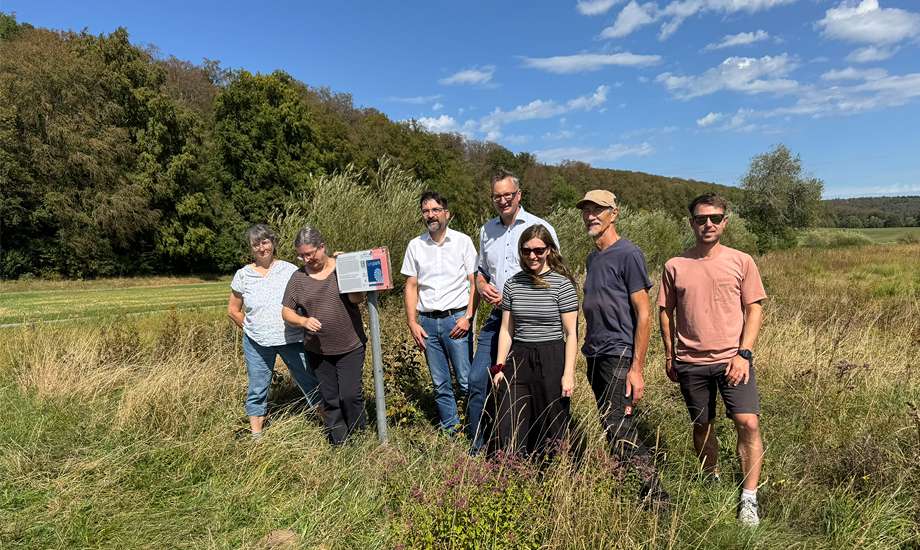
Andreas Schwarz out and about with the Geopark team in Gutenberg-Lenningen
Andreas Schwarz out and about with the Geopark team in Gutenberg-Lenningen
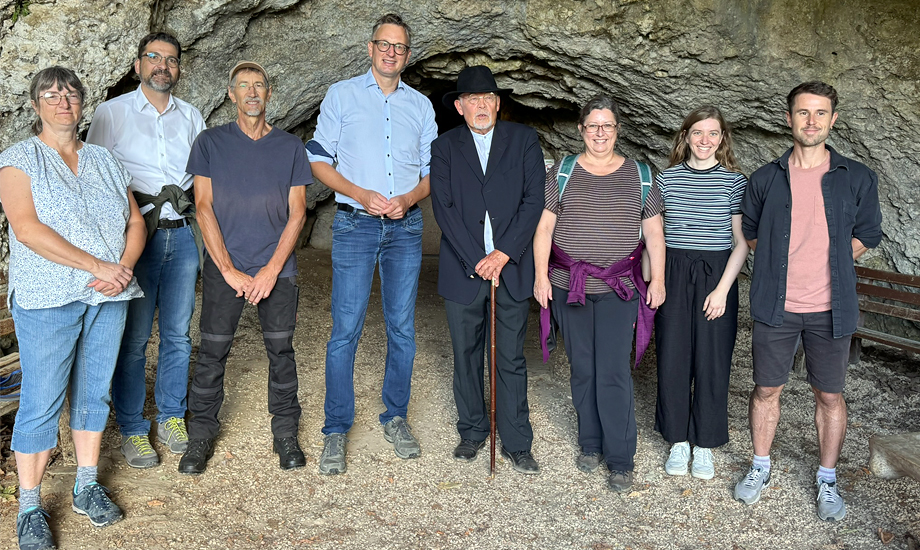
On September 7, as part of his summer tour of the Esslingen congressional district, Andreas Schwarz, a member of the Baden-Württemberg State Parliament and chair of the Green Party caucus, took three hours to learn about the UNESCO Global Geopark Schwäbische Alb and its work in the region. Together with the entire Geopark team, he visited three special geosites around Lenningen-Gutenberg. The focus was not only on the geological features but, above all, on the question of how to protect natural heritage, share knowledge, and develop the region sustainably.
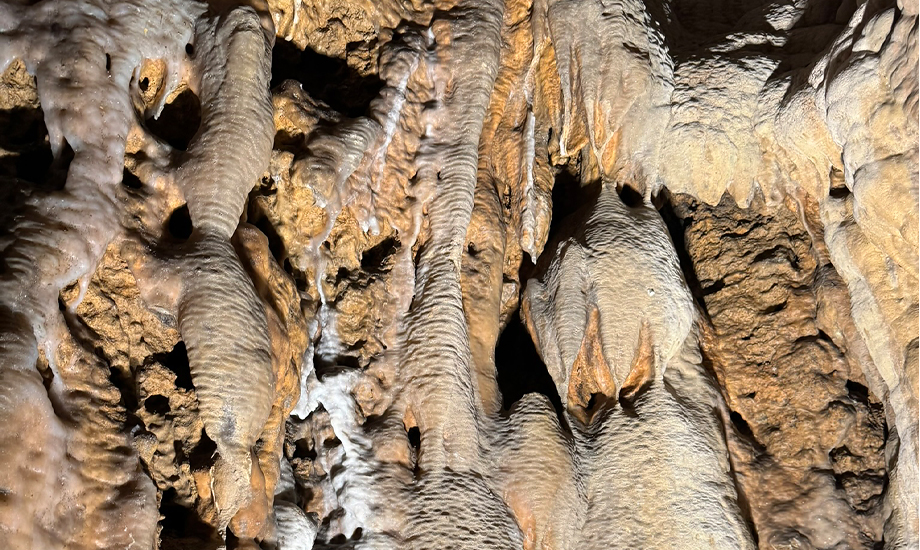
The excursion began at the Gutenberg Cave. Dr. Marius Schünke guided the group through part of the cave, taking on the role of speleologist and pastor Karl Gußmann, and recounted its discovery in 1889 by Gußmann and the first Swabian speleological society he founded. The Gutenberg Cave is a karst cave featuring stalactite and stalagmite formations and has a total length of approximately 200 meters. Of particular significance are the fossil finds from the first chamber: among the numerous skeletal remains, bone fragments of the Barbary macaque and the Alpine wolf were discovered.
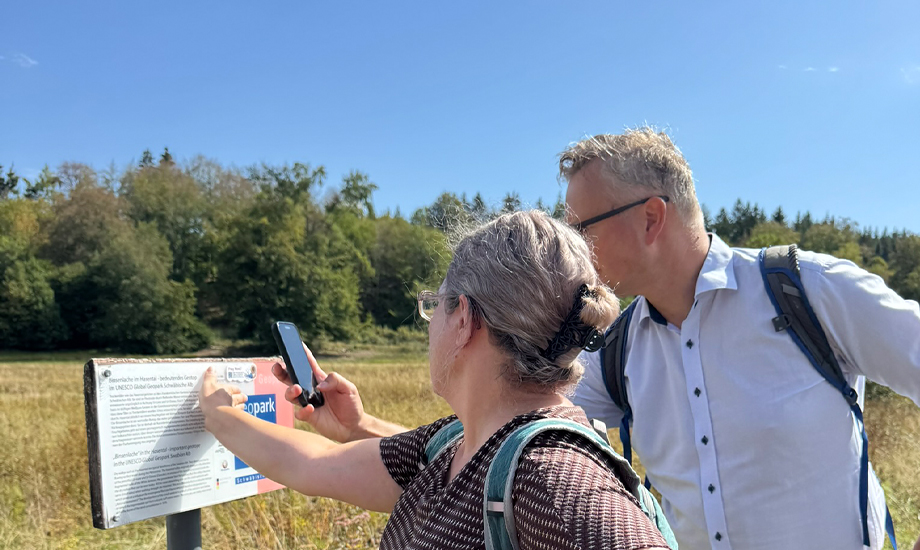
From the underground world, we then headed to the Binsenlache in the Hasental valley. At first glance, this wetland seems unremarkable. But its formation is all the more fascinating: The Binsenlache is located in a dry valley within the karst landscape, where rainwater normally seeps quickly into the ground. Here, however, volcanic deposits allow water to pool on the surface. The region around Lenningen is one of the areas of the Swabian Alb with particularly numerous traces of volcanic activity from about 15 million years ago.
Finally, the trail led to the sinter steps of the Weiße Lauter in Gutenberg. Sinter forms when calcium carbonate precipitates from water rich in lime. The terraces are thus a vivid example of how water not only shapes the landscape through erosion but also continues to create new geological structures to this day.
Geotope conservation begins with knowledge
At the same time, the three sites highlighted the challenge facing geotope conservation: Geotopes must be identified, documented, and assessed for their significance so that decisions can be made regarding the level of protection required in each case. For if evidence of Earth’s history is destroyed, the knowledge it holds is irretrievably lost.
An important tool for the Geopark is therefore the geotope registry, which is currently being updated for the area of the UNESCO Global Geopark. Geopark Executive Director Iris Bohnacker explained that the registry does not merely record the location of specific geotopes. Their condition, their protection status, and the question of whether further protection is necessary also play an important role. The Geopark itself cannot designate protected areas, but it can identify and document geotopes worthy of protection and forward relevant information to the appropriate authorities. The registry also serves as an important knowledge base for future work: Which locations are suitable for field trips? Where can knowledge be imparted? And where is special caution required?
This knowledge is also relevant for urban land-use planning and regional planning. State Representative Andreas Schwarz emphasized that special sites must be identified early on in order to balance protection and use. Iris Bohnacker added that not every geotope requires the same protective measures. However, she noted that stricter protection is necessary for particularly valuable or sensitive geotopes. “This also includes deliberately not designating sensitive sites as geopoints or promoting them publicly if additional attention would do them more harm than good,” said Bohnacker.
Protection Through Education and Responsibility for the Region
Another key topic of the discussion was education. The UNESCO Global Geopark focuses on Education for Sustainable Development (ESD). Through its 13 geopark schools, it teaches children and young people about the formation of the landscape and the connections between Earth’s history, nature, and human use of the land.
In addition to the protection of geotopes, the field trip also focused on the region’s development. Harald Röhner, mayor of Gutenberg, shared the community’s perspective. The Swabian Alb is an attractive destination for visitors, yet smaller towns face major challenges. “The fact that we no longer have an inn in town today shows how important it is to consider nature experiences and regional development together,” said Röhner.
Ulrich Ruckh, Chair of the UNESCO Global Geopark Schwäbische Alb, thanked Andreas Schwarz and his team for the open and engaging dialogue. He emphasized that direct dialogue between policymakers, local governments, specialized agencies, and the geopark is particularly important for preserving these unique records of Earth’s history in the long term while also making them accessible to the public in a responsible manner.
Andreas Schwarz was impressed by the insights into the Geopark’s work: “The Swabian Alb is a wonderful home and region where there is so much to discover. The caves invite you to visit and explore them. A big thank you to the Geopark team for this great event.”
INFO Andreas Schwarz is the leader of the Green Party caucus in the state parliament in Stuttgart.