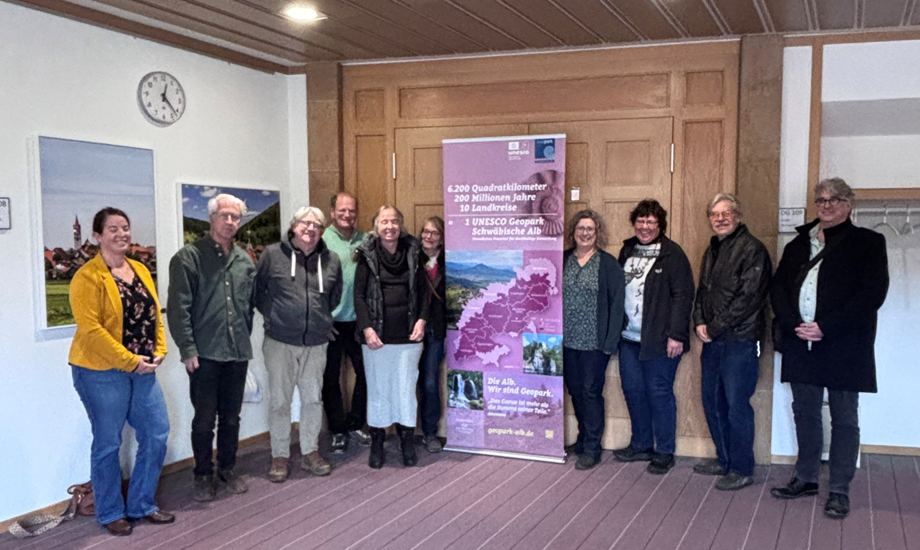
Geopark Advisory Board Meets in Schelklingen
Geopark Advisory Board Meets in Schelklingen
The UNESCO Schwäbische Alb Global Geopark has had an eventful year. At its advisory board meeting on November 18 at the office in Schelklingen, the focus was not only on reviewing the past year but, above all, on the geopark’s strategic development and future.
Ulrich Ruckh, chairman of the Geopark, welcomed the members of the advisory board. Managing Director Iris Bohnacker then provided an overview of the activities and developments over the past year.
In 2026, the Geopark had a particularly strong presence both in the region and beyond: at major events such as the Danube Festival in Ulm, the Ulrichsfest at the Berg Brewery, and the Agricultural Festival, as well as in the media. In addition, there were features in well-known publications, including “1,000 Places to See Before You Die – Swabian Alb.” Numerous posts on social media channels, up-to-date website news, and four newsletters further boosted visibility. The out-of-home campaign, featuring two poster display phases, was also part of the public relations efforts. The varied feedback on the poster designs was incorporated into their future use: Some designs are also set to be used as postcards in the future.
Auch das Netzwerk wächst weiter: Zum Jahresende zählt der Geopark 42 Geopoints, 25 Infostellen und 14 Geoparkschulen. Eine besondere Auszeichnung erhielt kürzlich der Schwäbische Vulkan, der in die „Third 100“ der weltweit bedeutenden IUGS Geological Heritage Sites aufgenommen wurde.
Setting the Course for the Coming Years
A key initiative is the update of the master plan for 2027 through 2031. Next year, the strategic direction, future tasks, and structure of the committees are to be reassessed. At the same time, preparations will begin for the next UNESCO re-evaluation, which is scheduled for 2028 and will include another site visit.
In this context, there was also discussion about broadening the composition of the advisory board. Topics such as education for sustainable development, sustainability, schools, and climate are to be given greater consideration in the future. Dr. Yvonne Tafelmaier, a research associate at the Institute for Natural Science Archaeology at the University of Tübingen (Prehistory and Early History), agreed to represent the field of archaeology and World Heritage. Wieland Scheuerle, a speleologist, was approached as a potential representative for the field of cave conservation and research.
Cooperation with universities and scientific institutions, the further development of Geopark schools, and the international INTERREG project “Danube GeoTour Plus” were also topics discussed at the meeting. Among other things, the discussion focused on new digital and tourism offerings, such as the Geopark app, which will soon be available for download in the App Store.
What Happens Next
The year 2027 will be marked by consolidation and strategic development. Projects already underway will continue, and programs for schools and other target groups will be expanded. At the same time, the master plan will be updated, and preparations for the 2028 UNESCO revalidation will move forward. The Scientific Advisory Board will also be closely involved in this process. Collaboration with regional stakeholders and partners remains an important part of our work. Highlights include the Geopark Festival on May 30 at the Panoramatherme in Beuren and the Geopark’s presence at the Garden Show in Bad Urach in August.