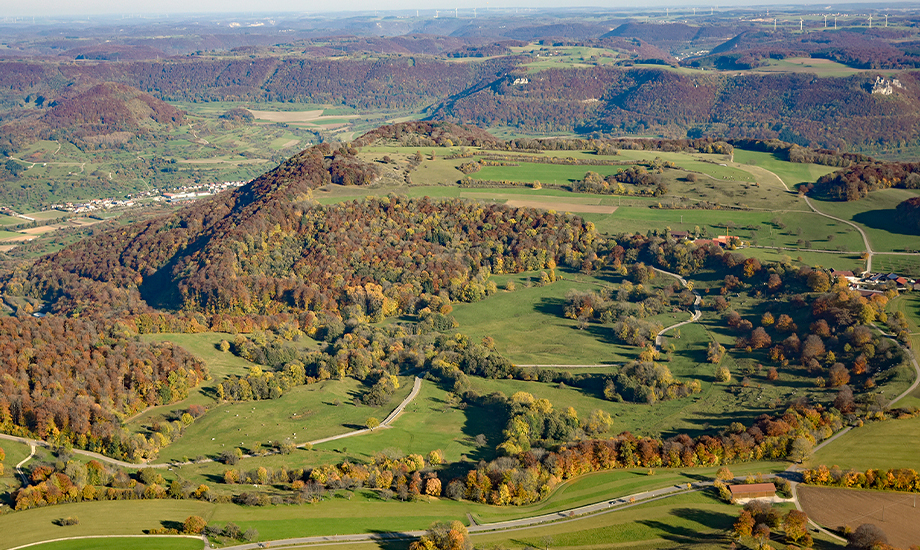
The Swabian Volcano is among the IUGS’s “Third 100”
The Swabian Volcano is among the IUGS’s “Third 100”
Mount Fuji in Japan, the Norwegian fjords, and the Chocolate Hills in the Philippines: They are all among the newly selected 100 geological sites of outstanding scientific significance. The Swabian Alb is also represented: The maars and diatremes of the Swabian Volcano have been included in the International Union of Geological Sciences (IUGS) list.
On November 6, 2026, the IUGS announced its third selection of “100 Geological Heritage Sites” during an international geoheritage event in Portugal. The newly included sites are spread across 47 countries, including 34 in Europe. Together with the two previous selections, the international collection now comprises 300 geological sites.
The History of Science as an International Flagship
The Swabian Volcano falls under the “History of Geosciences” category. In recognizing it, the IUGS specifically honors its contribution to the advancement of geoscientific research and to a better understanding of volcanic processes.
The international examples illustrate the diversity of the award: While Mount Fuji is classified in the “Volcanology” category, the Norwegian fjords and the Chocolate Hills in the Philippines fall under the “Geomorphology and active geological processes” category. The Swabian Volcano is thus being honored primarily for its significance in the history of science.
A Key Area for Volcanic Research
The Urach volcanic region covers approximately 1,600 square kilometers and includes about 350 documented volcanic diatreme features. Volcanic activity in the area dates back approximately 17 to 11 million years.
Characteristic features include so-called maars and diatremes: Maars are crater-like depressions formed by explosive eruptions when rising magma came into contact with groundwater. Diatremes are the associated funnel- or tube-shaped volcanic vents beneath the surface.
One unique feature is that, over the course of millions of years, erosion has exposed parts of these originally subterranean structures. As a result, researchers today can gain insights into the structure of former volcanic vents that are normally hidden deep beneath the Earth’s surface. Research on the Swabian Volcano has contributed significantly to a better understanding of the formation of such structures and the dynamics of magma ascent. A well-known example is the Randecker Maar.
For the UNESCO Schwäbische Alb Global Geopark, this designation represents a special form of international recognition. It underscores the region’s outstanding geoscientific significance and demonstrates that the Schwäbische Alb occupies an important place in the international history of the geosciences.
INFO
An “IUGS Geological Heritage Site” is a key geological site with exceptional features or processes of the highest scientific significance. It serves as an international reference for research and/or has contributed significantly to the development of the geosciences.
Quellen und weiterführende Informationen:
- IUGS: The Third 100 IUGS Geological Heritage Sites have been announced
- IUGS: Official Catalog of the Third 100 (PDF)