Identifying Barriers, Creating Access: Training for Landscape Guides in the Ermstal Valley
Identifying Barriers, Creating Access: Training for Landscape Guides in the Ermstal Valley
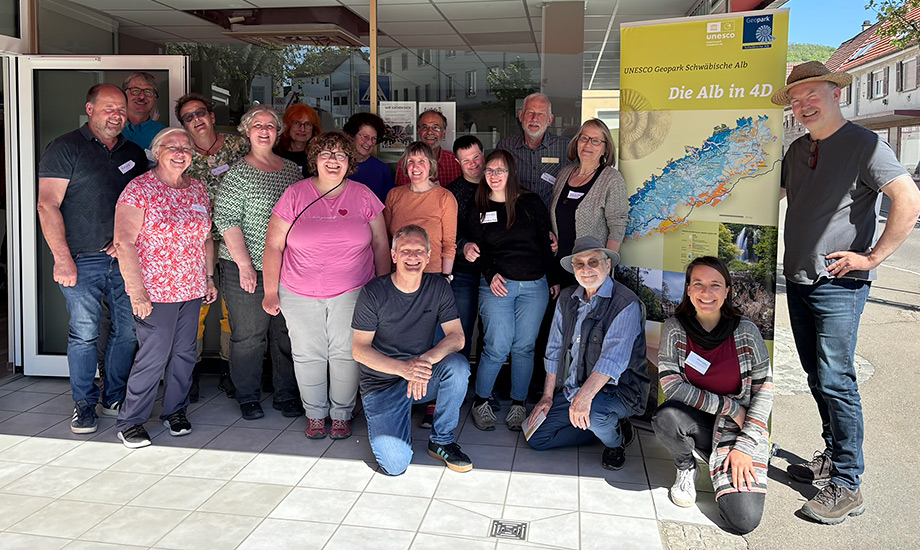
How can nature tours be designed so that as many people as possible can participate? A training session for nature tour guides held on April 25, 2026, at the Offene Hilfen Ermstal facility in Dettingen addressed this question. Initiated by the UNESCO Global Geopark Schwäbische Alb and conducted in cooperation with BruderhausDiakonie, the training focused on the topic of “Accessibility in Landscape Tours.”
The goal of the training was to raise awareness of various types of barriers and to develop concrete strategies for improving accessibility in guided nature tours. Twelve participants took the opportunity to engage in an in-depth exchange—both with one another and with representatives of the target group.
The involvement of the so-called “Action Checkers”—a group of people with disabilities who test recreational activities for accessibility—added significant value. Working alongside the BruderhausDiakonie team, they brought their perspectives directly into the training session and made the barriers they face in everyday life tangibly apparent.
Exchange and a change of perspective
The day got off to a practical start: Using activities like “get-to-know-you bingo” or the “pasta-pizza game,” participants not only got to know one another but also gained ideas for their own work with groups.
As the session progressed, it became clear just how diverse barriers can be. In a group brainstorming exercise, participants identified architectural obstacles such as uneven paths or missing ramps, as well as linguistic and organizational hurdles. In subsequent workshop phases, participants delved deeper into physical and linguistic barriers, shifting perspectives throughout the day.
Practical, interconnected, and forward-looking
The hands-on portion was particularly impactful: Participants were able to experience firsthand what it feels like to get around in a wheelchair or to walk with a white cane. These experiences heightened their awareness of seemingly minor obstacles that can have a major impact.
Linguistic accessibility was also addressed. The topic of “plain language” was touched upon, and participants discussed together where and how it can be effectively used in guided tours.
The training session was also part of the EU-funded Interreg project Danube GeoTour Plus, in which BruderhausDiakonie participates as a partner of the Geopark. One of the project’s goals is the inclusive and sustainable development of the region.
The event concluded with a joint feedback session. During this session, the desire for further training became clear—a sign of the topic’s high relevance in practical educational work.
The event was organized by Teresa Mangold (UNESCO Geopark) as well as Reiner Fritz and Anna Mickeleit from BruderhausDiakonie. Together, they led the program and ensured a close integration of theory and practice.
INFO: What is plain language?
Easy-to-read language is a greatly simplified form of German. It is primarily intended for people with learning or reading difficulties and follows set rules:
Key Principles
- short, clear sentences (one idea per sentence)
- simple, familiar words
- difficult terms are explained
- clear structure and paragraphs
- review by the target audience
Plain language helps make information easier to understand—and is therefore a key component of greater accessibility.