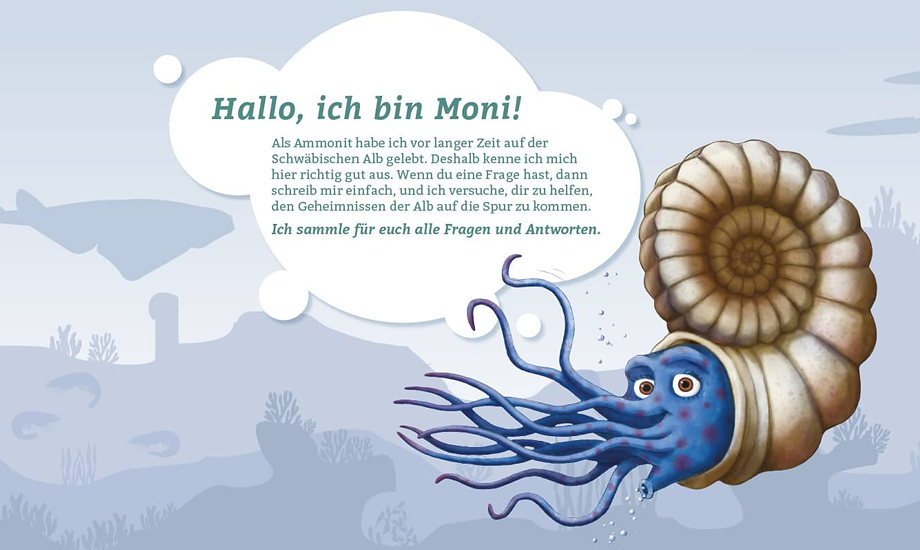
Moni - our ambassador from prehistoric time - introduces herself
Moni - our ambassador from prehistoric time - introduces herself
The UNESCO Global Geopark Swabian Alb is getting a mascot: Moni, a fossilized ammonite, will be the face of our new “Ask Moni” section on our website. With her, we want to get kids and families excited about the geological history of our region—in a way that's easy to understand, encourages conversation, and has a bit of fun.
Moni is an acronym for “ammonite”, which is what she is: a fossilized cephalopod from the time when the Swabian Alb was still covered by a tropical sea. As a fictional character, Moni draws on this geological history. She symbolizes the many fossils found in the limestone of the Alb and the enormous periods of time during which our landscape developed. Moni helps to convey complex content in a clear and age-appropriate way.
“Ask Moni” – a new section on the website
Under the title “Ask Moni,” the character now has a permanent place on our website. Children—and adults, of course—can ask questions about fossils, caves, karst, water, or the formation of the Swabian Alb. We receive the questions by email.
The contributions are published in a clear FAQ structure in easily understandable language. Questions such as “Why are there so many caves here?” or “Where did the sea that used to be here go?” are edited, answered, and then published.
Go directly to the question with the QR code
Over the next few weeks, Moni will not only be present digitally, but also outdoors in the countryside. Stickers with a QR code are planned to be placed at selected geopoints, information boards, and information points. Anyone who scans the code will be taken directly to the “Ask Moni” section and can submit their own question. In this way, the project combines the experience of nature on site with a digital dialogue on the website.
Bringing knowledge to life
With Moni, the UNESCO Swabian Alb Geopark is expanding its educational offerings with a low-threshold, dialogue-oriented format. The character is designed to spark curiosity, encourage questions, and inspire people to discover the region's geological history for themselves. Because behind every fossil there is a story—and Moni helps to tell it.
Ammonites are among the most common fossils in our region and are also impressive witnesses to a world long gone. Millions of years ago, they lived in the tropical sea that was located where our landscape is today. Their fossilized remains can still be found in the region's limestone. Moni takes up this geological history and turns it into a narrative bridge between the past and the present.